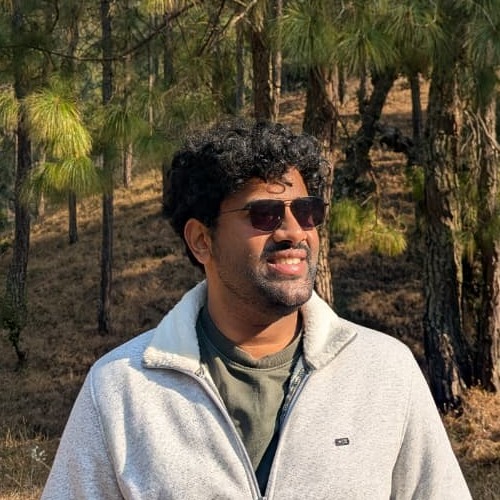
Applied AI/ML Research Engineer with 4 years of work experience and an M.S. from NYU (graduated May 2026). Passionate about building efficient, state-of-the-art machine learning and computer vision systems. Actively seeking AI/ML Engineer and Research Scientist roles.
Academic Projects
My graduate projects at NYU showcasing expertise in efficient AI and modern machine learning systems, including vision-language models, large language models, retrieval-augmented generation (RAG) and diffusion models.
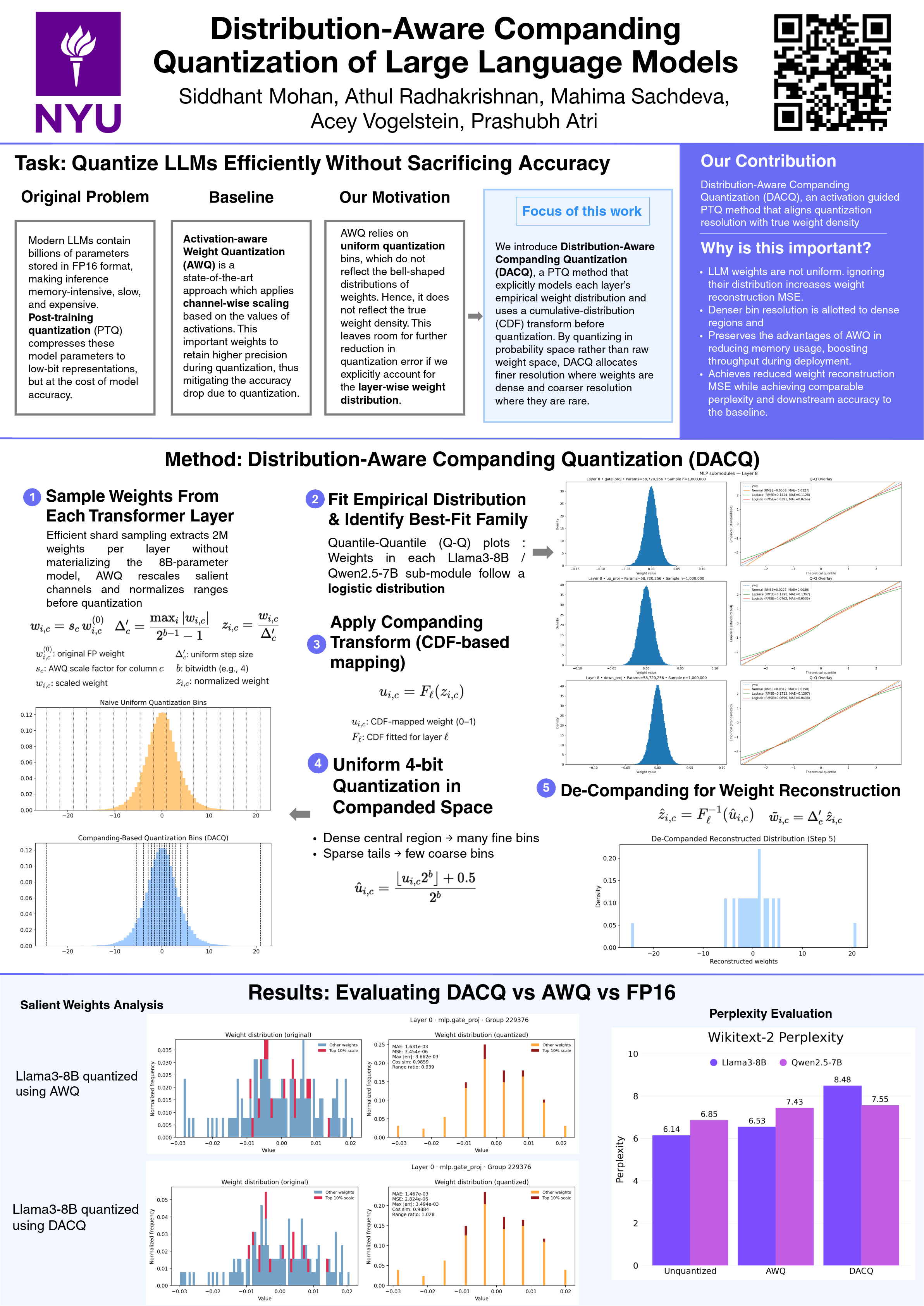
Distribution-Aware Companding Quantization (DACQ)
DACQ is a post-training quantization method for large language models that uses distribution-aware companding to better preserve model weights under low-bit precision. It aims to improve upon Activation Aware Quantization (AWQ) by using non-uniform quantization bins based on the distribution instead of uniform quantization bins. The project studies the trade-off between weight reconstruction error, benchmark performance, and deployment efficiency across LLMs like Llama3-8B and Qwen2.5-7B, using benchmark datasets such as MMLU and WikiText-2. It reduces weight reconstruction error (MSE/MAE) by 20% compared to AWQ, while maintaining competitive accuracy and perplexity.
Stack: PyTorch • HuggingFace • CUDA • HPC (Slurm) • Statistical Modeling
Models: Llama3-8B • Qwen2.5-7B
Datasets: MMLU • WikiText-2
Keywords: LLM Optimization • Post-Training Quantization • Companding • Efficient AI • Model Compression
Efficient Vision-Language Generation with Semantic Prompt Clustering on HART
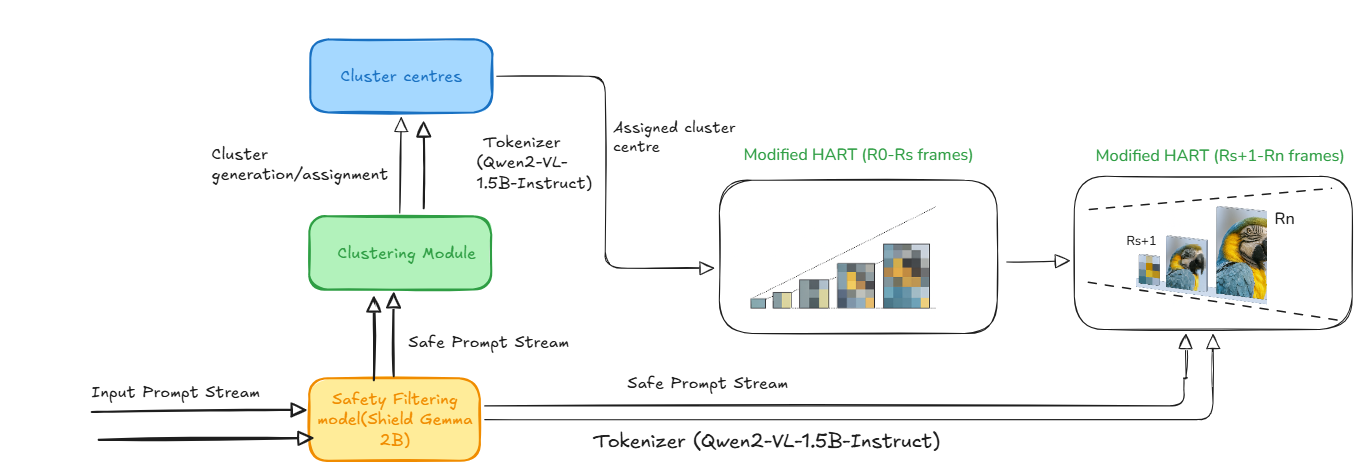
Designed an efficient generation pipeline for Hybrid Autoregressive Transformer (HART), which produces images through low-resolution generation followed by multiple autoregressive refinement stages.
The project reduces redundant early-stage computation by clustering semantically similar prompts, sharing their coarse visual generation, and reintroducing prompt-specific conditioning during later refinement.
Stack: PyTorch • HuggingFace • HDBSCAN • CUDA • HPC (Slurm)
Model: Hybrid Autoregressive Transformer (HART)
Datasets: ImageNet-1K • MJHQ-30K
Keywords: Vision-Language Generation • Efficient Generative AI • Prompt Clustering • Autoregressive Refinement • Compute Reuse
🚀 Results
- Reduced redundant forward passes by sharing low-resolution generation across semantically similar prompts
- Lowered compute and memory usage in the early stages of the generation pipeline
- Achieved approximately 20% improvement in computational efficiency while maintaining generated image quality
💼 Work Experience
Senior Research Engineer — Toshiba Software India (R&D)
2020 – 2024
Led applied AI research projects in industrial computer vision and manufacturing systems.
- Incremental Learning: Engineered an incremental learning pipeline for a single-shot object detector model, using knowledge distillation and weight importance-based regularization, which enabled adaptation to new object classes without forgetting old classes, improving mAP by 15% on COCO and VOC.
- Unsupervised Anomaly Localization: Directed a team in developing an unsupervised approach for localizing anomalies in industrial images using feature extractors and k-nearest neighbor statistics. Outperformed baselines on the MVTec-AD dataset by 22%.
- Domain Adaptation: Managed a project on implementing domain adaptation for key-point detection in arc-welding images, using mix-up augmentation. Achieved an improvement of 12% over the baseline.
- Systems & Infrastructure: Configured and deployed NVIDIA GPU workstations from scratch to set up an R&D lab, including Ubuntu, CUDA, cuDNN driver setup, PyTorch environments for deep learning, reducing compute costs by 30% annually compared to equivalent commercial cloud usage.
🎓 Education
New York University (NYU) Tandon School of Engineering
M.S. Electrical Engineering — May 2026
Coursework: Machine Learning, Deep Learning, Computer Vision, NLP, Efficient AI, Probability & Statistics
Indian Institute of Technology (IIT) Tirupati
B.Tech. Electrical Engineering — June 2020 Coursework: Image Processing, Medical Imaging, Digital Signal Processing, Basic Graph Theory
🛠 Technical Skills
Languages: Python, C/C++, SQL, MATLAB
Frameworks: PyTorch, TensorFlow, HuggingFace, Ray, MLflow, OpenCV, OpenMMLab, MLFlow, Ray, Scikit-Learn, ONNX, Numpy, Scipy, Pandas, Matplotlib
Systems: CUDA, Distributed Training, Docker, Linux, Slurm
Focus Areas: LLM Optimization, Quantization, Efficient AI Systems, Computer Vision